Imagine digging through a drawer of old kitchen gadgets and finding a small metal piece you’ve never seen before — something you can’t identify at all.
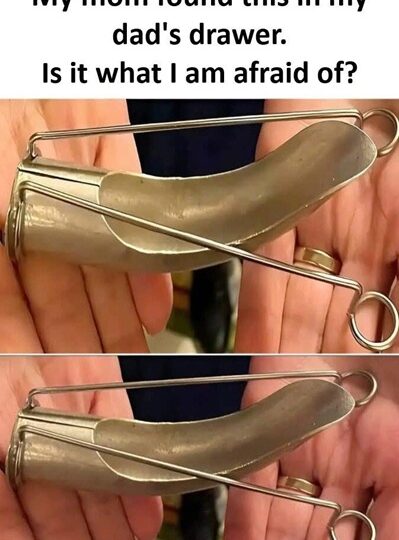
It looks a bit like a spout or mini funnel, with strange curves and thin wire parts, almost like it belongs in a toolbox instead of next to measuring cups and spatulas.
For many people, especially anyone unfamiliar with vintage appliances, an item like this can be completely confusing. But chances are, it isn’t random at all. It’s most likely a part from a Sunbeam Mixmaster juicer attachment — a clever add-on made for one of the most famous kitchen machines of the 20th century.
This isn’t just scrap metal. It’s a leftover from an era when appliances were built to do more than one job, and when everyday kitchen tools were designed with surprisingly thoughtful engineering.
The piece you found is most likely the spout-and-strainer assembly from a Sunbeam Mixmaster citrus juicer attachment — used to pour fresh juice neatly while filtering out seeds and extra pulp.
Sunbeam Mixmaster: A Quick Look Back
To understand what this part is, it helps to know the machine it came from.
Sunbeam Products, founded in 1897, became one of America’s biggest names in household appliances. In 1930, they released what would become one of their most iconic creations: the Sunbeam Mixmaster.
Back when electric kitchen tools were still new, the Mixmaster stood out for being powerful, dependable, and easy to use. Its signature feature was its two interlocking beaters, which mixed far better than most tools available at the time.
Over the years, Sunbeam upgraded the motor, added speed settings, and created a wide range of optional accessories. Some models even allowed the mixer head to detach and be used separately.
But what truly made the Mixmaster special wasn’t just mixing — it was what it could become with attachments.
More Than a Mixer: The Attachment Era
Sunbeam leaned hard into the idea of one appliance doing multiple jobs. With the right add-ons, the Mixmaster could be transformed into a full kitchen workhorse.
Depending on the model and decade, attachments included:
-
Citrus juicers
-
Meat grinders
-
Food choppers
-
Slicers and shredders
-
Drink mixers
-
Knife sharpeners
-
Coffee grinders
-
Butter churns
-
Potato peelers and more
Many of these accessories faded away as modern appliances became more specialized — but the juicer attachment remained one of the most popular and commonly found.
How the Mixmaster Juicer Worked
Unlike today’s stand-alone electric juicers, the Mixmaster juicer relied entirely on the mixer’s motor.
Most classic Mixmasters had a power take-off port (a drive point on the mixer head). The juicer attachment connected there and used the motor to spin the reamer.
Here’s how it worked in simple terms:
-
The attachment was mounted onto the mixer.
-
A special bowl sat underneath.
-
A rotating cone-shaped reamer extracted juice as citrus fruit was pressed down.
-
The spout and wire strainer guided the juice outward while trapping seeds and pulp.
So the part you found wasn’t decorative — it was essential. It acted like a built-in filter and pouring channel.